
Match Tool Material to Workpiece and Volume for Optimal Machining Performance
Selecting the optimal tool material requires balancing workpiece characteristics, production volume, and cost-efficiency. Harder materials like hardened alloys demand greater wear resistance, while high-volume runs prioritize longevity over initial investment.
Carbide vs. HSS vs. Ceramic: Strengths, Limitations, and Cost-Performance Trade-offs
In high speed machining operations involving steels and cast irons, carbide tools are generally preferred despite costing roughly double what HSS tools do. They last anywhere from three to five times longer though, which makes them worth the investment for most shops doing regular production runs. Ceramic inserts perform exceptionally well when cutting superalloys at temperatures exceeding 1000 degrees Celsius, but shop owners often avoid them for jobs with frequent start stops since they tend to crack under those conditions. High Speed Steel still holds its own place in small batch aluminum work because it can be resharpened multiple times before needing replacement, even though it doesn't produce parts as quickly as carbides. When working with titanium alloys, coated carbide bits seem to strike just the right balance between resisting heat damage and protecting against chemical wear that plagues other tool materials.
Material-Specific Recommendations: Machining Steel, Aluminum, Composites, and Hardened Alloys
| Material | Tool Recommendation | Critical Parameters |
|---|---|---|
| Steel (HRC <45) | TiAlN-coated carbide | Positive rake, high helix |
| Aluminum | Uncoated carbide/PCD | Sharp edge, high clearance |
| Composites | Diamond-coated tools | Low feed, high RPM |
| Hardened alloys | Ceramic/SiAlON | Constant engagement |
Putting diamond coatings on composite cutting tools really helps reduce those pesky issues with fiber pull out and delamination during machining. For working with hardened steels over 45 HRC, ceramic tools hold their shape pretty well dimensionally. Still need to be careful though because these tools chip easily if not set up properly in a stable machine environment. Worth running some test cuts before full production just to make sure everything works as expected. Thermal expansion differences between the tool material and what we're cutting can actually lead to tolerance problems down the line. We've seen cases where tolerances drift past 0.1 mm when scaling up operations, which definitely causes headaches for quality control teams later on.
Select Machining Tool Geometry and Type by Operation and Feature Requirements
End Mills, Turning Inserts, and Drills: Functional Roles and Machining Application Boundaries
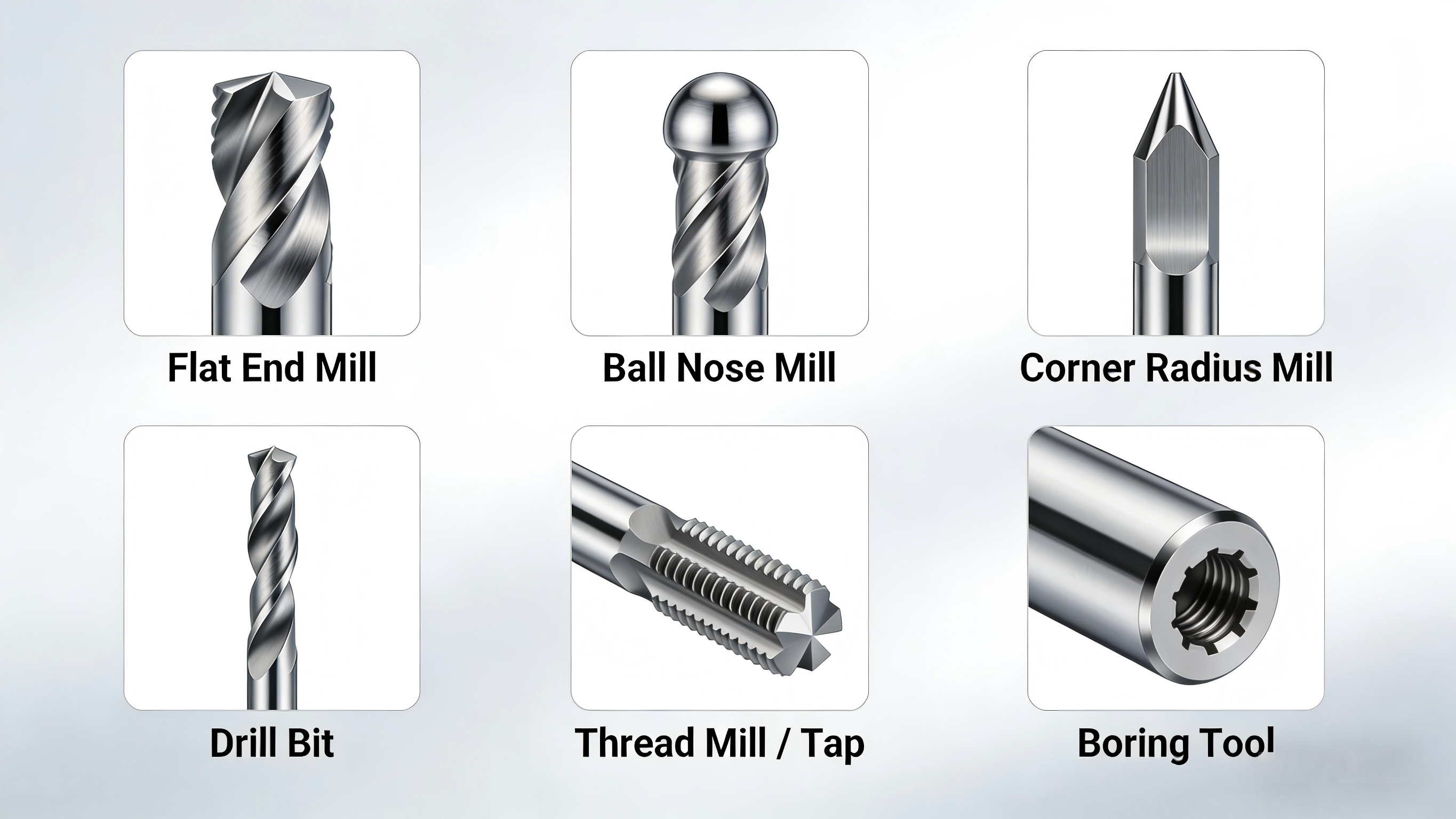
End mills work really well for jobs that need multiple cutting points such as profiling and pocketing tasks, particularly when dealing with complicated shapes and contours. Turning inserts function as single point cutting instruments designed specifically for shaping cylinders on lathes. Standard drills are all about making holes quickly, and most people stick with twist drill bits for regular through hole work. These different tools have pretty clear limits what they can do. For instance, end mills just aren't good for drilling deep holes, turning inserts won't cut it for milling operations, and ordinary drill bits typically leave behind rougher surfaces than reamers would achieve. When machinists pick the wrong cutting tool, they often see their equipment wearing out much quicker maybe even 70% faster than normal and end up with parts that don't meet specifications, sometimes off by more than half a thousandth of an inch.
Rake, Helix, and Clearance Angles: Impact on Chip Control, Heat Management, and Surface Finish
The geometry of cutting tools plays a major role in how chips form, how heat spreads out during machining, and what kind of finish ends up on the workpiece. When it comes to rake angles, positive ones cut down on cutting forces somewhere around 15 to 20 percent, though they do make the tool edges more prone to chipping. On the flip side, negative rake angles stand up better against tough materials like hardened steel alloys, even if they require more power to run. For aluminum milling jobs, helix angles ranging from about 25 degrees up to 45 degrees work best for getting those chips out of the way before they get recut and ruin the surface finish. Clearance angles need to stay above six degrees to keep friction generated heat from building up too much, but go beyond that and the cutting edge becomes vulnerable. Finish cuts typically use narrower helix angles thirty degrees or less combined with smooth flute surfaces to hit those sub 32 Ra surface finishes. Rough cuts meanwhile benefit from steeper helix angles forty five degrees and above since they help move heat away faster during heavy cutting operations.
Leverage Advanced Coatings to Enhance Machining Efficiency and Tool Life
TiN, TiCN, and DLC Coatings: Comparative Analysis for Wear Resistance and Thermal Stability
Tool coatings have become essential for extending tool life while improving overall efficiency through reduced friction and less thermal damage during operation. Take Titanium Nitride (TiN) for example it works pretty well against wear up until around 600 degrees Celsius, which makes it a go to option for most standard steel machining jobs. Then there's Titanium Carbo Nitride (TiCN), which brings better hardness properties and can handle temperatures going all the way up to 750 degrees. This makes TiCN especially good when working at higher speeds with tough or abrasive materials that would normally wear down tools quickly. Diamond Like Carbon (DLC) coatings are another story altogether they offer amazing hardness levels and create very low friction surfaces. However, DLC has temperature limitations typically between 300 and 400 degrees Celsius unless special versions like tetrahedral amorphous carbon (ta C) are used instead. These temperature constraints mean DLC isn't always suitable for every application despite its impressive performance characteristics.
- Wear Resistance: DLC > TiCN > TiN
- Thermal Limits: TiCN (750°C) > TiN (600°C) > DLC (400°C)
- Material Suitability: TiN for mild-to-medium steels, TiCN for hardened alloys and stainless, DLC for non-ferrous metals and composites
Matching coatings to workpiece material prevents premature failure and reduces unplanned downtime.
Integrate Machining Tool Selection with Process Planning and CNC Capabilities
When making tooling choices, it's essential they match what the CNC machine can actually handle physically and through its control systems. Things like spindle power levels, how torque changes at different speeds, top RPM limits, and how the machine swaps tools all matter greatly when trying to prevent slowdowns or premature wear on equipment. Take a high feed rate end mill designed specifically for working with titanium as an example case study. These tools need very rigid setups and solid fixtures just to reach their performance specs. For multi axis contouring work, precision becomes even more critical. Tools need exact geometry specifications plus thermal stability coatings so they maintain accuracy over those complicated surface shapes. Looking at process planning helps determine what kind of tools make sense too. When running large volumes, spending extra on premium carbide tools with those fancy coatings pays off in the long run. But during prototype development stages, many shops find themselves going with HSS options because they offer greater flexibility. Getting this right means better chip removal, less vibration issues, and makes full use of what the CNC system is capable of mechanically. Recent data from SME in 2023 shows that companies who coordinate their tool selections with overall process design see around 15 to 20 percent reductions in cycle time and can stretch out tool usage up to 30 percent longer. This comprehensive strategy turns machining operations away from being just a series of separate steps toward creating something much more integrated and productive overall.
Frequently Asked Questions (FAQ)
What factors should I consider when selecting a machining tool material?
You should consider workpiece characteristics, production volume, and cost-efficiency. Harder materials require greater wear resistance, while high-volume production prioritizes tool longevity.
Why are carbide tools often preferred in machining operations involving steel?
Carbide tools offer longer tool life, lasting three to five times longer than HSS tools, making them cost-effective for regular production runs despite their higher initial cost.
What are the advantages and disadvantages of using ceramic tools?
Ceramic tools are excellent for cutting superalloys at high temperatures but are prone to cracking in jobs with frequent start-stops.
How do tool coatings like TiN and TiCN enhance machining efficiency?
Tool coatings extend tool life, reduce friction, and minimize thermal damage during operation, enhancing overall machining efficiency.
How does integrating tool selection with process planning and CNC capabilities benefit machining operations?
Integrating tool selection with process planning ensures compatibility with CNC systems, reduces cycle time by 15 to 20 percent, and extends tool usage up to 30 percent.
Table of Contents
- Match Tool Material to Workpiece and Volume for Optimal Machining Performance
- Select Machining Tool Geometry and Type by Operation and Feature Requirements
- Leverage Advanced Coatings to Enhance Machining Efficiency and Tool Life
- Integrate Machining Tool Selection with Process Planning and CNC Capabilities
-
Frequently Asked Questions (FAQ)
- What factors should I consider when selecting a machining tool material?
- Why are carbide tools often preferred in machining operations involving steel?
- What are the advantages and disadvantages of using ceramic tools?
- How do tool coatings like TiN and TiCN enhance machining efficiency?
- How does integrating tool selection with process planning and CNC capabilities benefit machining operations?