 EN


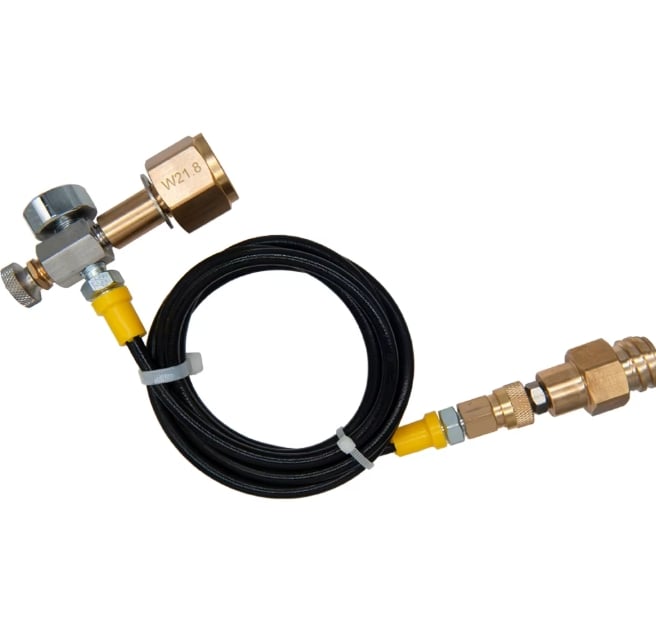
The appeal of a 60-inch stainless steel hose adapter is not convenience. It is geometry. Most residential kitchens do not have a dedicated fill station. The donor CO2 tank sits on a utility cart, a garage shelf, or the floor of a pantry. The SodaStream cylinder needs to reach a scale, and the scale needs to sit on something flat. A 36-inch hose forces both objects into each other’s workspace. A 60-inch braided stainless line gives enough slack to keep the donor tank upright and stable while the receiving cylinder is weighed on a bench. That extra two feet of reach is the difference between a controlled fill and a wrestling match with a pressurized vessel.
The adapter is not the part that decides whether the fill is safe
A CGA 320 to TR21-4 adapter with a braided stainless hose is a mechanical bridge, nothing more. It does not regulate pressure, and it does not tell the operator when to stop. The CGA 320 connection mates to the donor tank’s valve outlet, a standard found on most CO2 cylinders used in beverage and welding gas service in North America. The TR21-4 side threads onto the small SodaStream cylinder. Between the two sits a length of flexible stainless braid, typically rated around 3000 psi working pressure with a much higher burst threshold. The adapter’s job is to contain gas and transmit it without leaking. The operator’s job is to control how much gas moves, and that is where most failures in home refilling begin.
A braided stainless cover does not mean the hose is indestructible. It means the inner polymer core is protected from abrasion and kinking. The core is still the pressure boundary. Hoses left in a coiled position under tension will eventually fatigue at the crimp. The 60-inch length reduces that tension because the hose does not need to be stretched tight to reach the cylinder.
The receiving cylinder has a safety device that deserves respect
SodaStream cylinders are not empty vessels waiting to be overfilled. The valve body contains a burst disc designed to vent the contents to atmosphere before the cylinder shell reaches its test pressure. That disc is a last line of defense, not a fill indicator. If a refill is pushed until the disc ruptures, the cylinder has already been subjected to conditions it was never meant to see in normal service.
There is another clock running inside every SodaStream cylinder. The gas itself does not expire, but the cylinder must be inspected or retired by a date printed on the bottom of the aluminum body. A cylinder past that date is not a candidate for refilling, regardless of how good the adapter is. The same applies to cylinders with dents, gouges, or a damaged valve. A pressure vessel with a compromised wall is not a bargain.
The table below puts the pressure numbers and service life markers in one view.
| Parameter | Typical value or rule | Why it matters during a refill |
|---|---|---|
| Adapter hose working pressure | ~3000 psi (206 bar) | Normal CO2 vapor pressure at room temperature stays far below this |
| Adapter hose test pressure | ~8000 psi | Indicates burst margin, not a safe operating target |
| SodaStream cylinder inspection date | Printed on cylinder base | An expired cylinder should not be refilled |
| Full SodaStream cylinder weight (approx.) | Around 750 g or more for a 60 L cylinder | A kitchen scale is the only reliable fill gauge |
| Donor tank type | Non-siphon, CGA 320 vapor outlet | A siphon tank pulls liquid CO2 and can overpressure the small cylinder |
Weight is the only honest gauge in the room
The single most useful piece of equipment for this job is not the adapter. It is a digital kitchen scale that reads in grams. A SodaStream 60 L cylinder holds a small, fixed mass of CO2. The exact full weight varies slightly by cylinder generation, but the principle does not: the receiving cylinder must be chilled before the fill, weighed empty, and then filled until the gain matches the target charge. SodaStream itself uses weight as the field test for an empty cylinder, noting that a cylinder reading under roughly 750 g is spent.
Chilling the empty cylinder before connecting it is not a trick to make the fill “faster.” It is a way to keep the pressure differential manageable. A cold cylinder has a lower internal vapor pressure, so CO2 flows in more gently when the donor valve cracks open. A room-temperature cylinder fills quickly at first, then the pressure equalizes, and the operator is tempted to crack the valve wider to force more gas in. That is the moment when the burst disc becomes relevant.
The fill itself should be done in short pulses with the donor valve barely open. The scale reading is the stop signal. When the target weight gain is reached, the donor valve closes, the bleed valve on the adapter vents the trapped pressure in the hose, and only then is the TR21-4 nut loosened. Skipping the bleed step puts full hose pressure against the threads as they separate, which is hard on the O-ring and the operator’s knuckles.
Compatibility is narrower than the product listings suggest
Not every SodaStream cylinder uses the same connection. The TR21-4 threaded fitting on a standard blue cylinder is not the same interface as the quick-connect collar found on Terra, DUO, and ART machines. Adapters built around a TR21-4 male thread will thread onto the older screw-in cylinders, but they will not lock onto a quick-connect cylinder without a different fitting. Many listings bury this in a compatibility note, and buyers discover the mismatch only after the donor tank is already connected.
The donor tank side has its own requirement. A standard CGA 320 cylinder with a vapor outlet works. A siphon-equipped CO2 tank, the kind used for liquid draw in some industrial service, will send liquid CO2 into the small cylinder. Liquid expansion inside a cylinder sized for vapor service is a serious overpressure scenario. The adapter does not correct for that. The tank valve type determines what comes through the hose.
The cost case is real, but the risk does not disappear
The financial argument for refilling is straightforward. A SodaStream cylinder exchange in the US typically runs around $15 for a 60 L cylinder, and the retail price without an exchange is higher. Bulk beverage-grade CO2 costs a fraction of that per fill. For a household going through several cylinders a month, the adapter pays for itself over a reasonable service interval.
The hidden cost is the equipment and attention required to do it correctly. A regulated donor tank, a reliable scale, a chilled cylinder, and a workspace where a vented burst disc would not injure anyone or damage anything. Beverage-grade CO2 is also not optional. Industrial CO2 can carry compressor lubricant residue and other contaminants that a home refiller has no practical way to test for. The cylinder is going into drinking water. The gas source should be specified for that service, with purity documentation behind it.
One more limitation deserves a direct statement. Third-party refilling of SodaStream cylinders can affect the manufacturer’s position on the cylinder, and SodaStream’s own literature warns that unauthorized refilling may be dangerous and may violate the terms attached to the cylinder. That does not make the practice mechanically impossible. It makes the responsibility land entirely on the person holding the adapter and the scale.
A 60-inch stainless hose adapter makes the physical arrangement of a home refill station easier to manage. It does not make the fill automatic, and it does not remove the need to weigh the cylinder and respect the service date. Those two habits matter more than the hose length. HXJ manufactures CGA 320 and TR21-4 adapter assemblies with braided stainless hoses, and the production side of that work is built around dimensional consistency at the thread interfaces and pressure-boundary testing before the assembly leaves the line. For anyone sourcing these fittings at volume, the difference between a reliable adapter and a frustrating one usually comes down to whether those checks are part of the process or an afterthought.