 EN


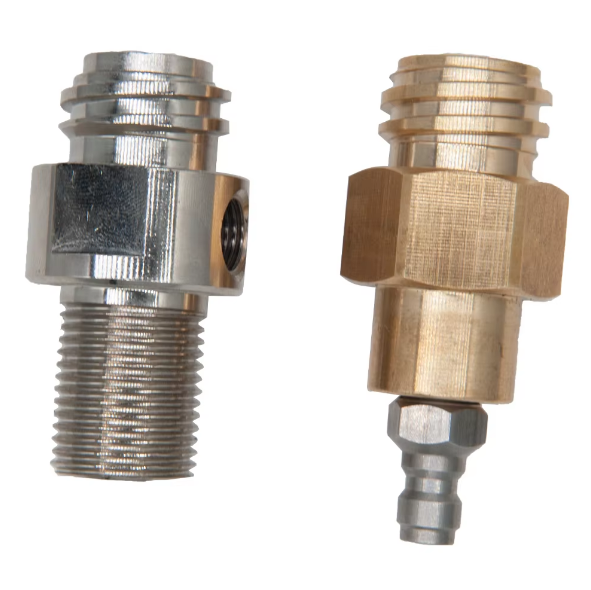
A commercial refill station is not a consumer accessory. It sits in the back of a restaurant, a convenience store, or a commissary kitchen, and it gets connected and disconnected dozens of times a week. The adapter threads on and off the same cylinder valve until the threads either hold their geometry or they do not. That duty cycle is the entire argument. Commercial soda machine distributors who specify brass over plastic are not making a materials-science statement. They are making a maintenance-cost statement, and the numbers behind it are not close.
The connection is the failure point, not the fitting body
An adapter body rarely fails in the middle. The wall thickness is generous, the alloy is homogeneous, and the pressure boundary has no seam. What fails is the interface: the thread engagement, the sealing surface, and the area where the hose crimp meets the fitting. Commercial refill stations load that interface hundreds of times per year, and every make-and-break cycle leaves a small, cumulative mark.
Brass, typically a copper-zinc alloy in the 60/40 range, has been the reference material for gas regulation fittings for decades because it machines cleanly and holds a thread form under repeated torque. Plastic does neither as well. A molded plastic thread deforms elastically every time a nut is torqued against it. Over enough cycles, that elastic recovery stops being complete. The thread crests flatten, engagement depth decreases, and the fitting begins to rely on the sealant or O-ring to do work the thread was supposed to share.
There is a comparison worth putting in front of anyone specifying these stations.
| Failure mode under repeated connection cycles | Brass adapter | Plastic adapter |
|---|---|---|
| Thread deformation per cycle | Minimal, elastic recovery stays largely complete | Progressive creep and crest flattening |
| Thermal expansion (CTE, ×10⁻⁶ m/m·°C) | 19–21 | PVC around 54, CPVC around 63 |
| Susceptibility to embrittlement from sanitizers and UV | Low | Moderate to high, depends on polymer and stabilizers |
| Consequence of a degraded seal | Leak path usually visible at the thread or O-ring | Cracking can propagate through the body wall |
| Typical service life in comparable compression fitting service | 20–50 years | 10–20 years |
The CTE gap matters more than it looks. Brass expands at roughly 19 to 21 micro-meters per meter per degree Celsius, while PVC moves at about 54 and CPVC at about 63. A commercial refill station sees temperature swings from a cold cylinder coming off a delivery truck to a warm back room, plus the cooling that happens when CO2 expands through the valve. A plastic fitting and a brass cylinder valve do not expand and contract at the same rate. Every cycle works the thread engagement a little differently, and that differential accumulates as stress fatigue at the joint interface.
Plastic does not crack on day one, and that is the problem
A plastic adapter that fails immediately is easy to deal with. It gets returned, the distributor eats the cost, and the spec gets revised. The dangerous failure is the one that happens after eight months of service, when the fitting has been exposed to a year of food-grade sanitizers, back-room temperature cycles, and the mechanical load of a hose hanging off the outlet.
Polypropylene and similar polymers are susceptible to embrittlement from prolonged temperature exposure and to cracking from external vibration that metal handles without issue. Commercial refill stations are not gentle environments. A hose connected to a plastic adapter puts a bending moment on the thread root every time the hose is moved. Brass distributes that load through a ductile cross-section. Plastic concentrates it at the mold line or the thread root, and a crack that starts there does not need to grow far before the pressure boundary is compromised.
One field observation from a beverage gas setup is worth noting. A shop that moved to plastic quick-connects for gas hose couplers found they performed acceptably for a period, but the O-rings needed periodic replacement in cooler environments, and the fittings were not immune to mechanical damage from routine handling. That is not a condemnation of plastic. It is an honest accounting of where the maintenance attention shifts. With brass, the attention goes to thread lubrication and torque discipline. With plastic, the attention goes to inspection for cracking, discoloration, and seal degradation, because the failure gives less warning.
Commercial distributors are buying uptime, not a lower unit price
The per-unit price gap between a brass adapter and a plastic one is real. Brass costs more at the counter. What distributors actually compare is the cost of a leak call, a lost CO2 charge, and a service technician dispatched to a site that is losing carbonation during a Friday dinner rush.
A leak at a refill station has a compounding cost structure. The gas itself is cheap per pound. The lost product downstream is not. A slow leak on the low-pressure side of a beverage gas system can drain a cylinder over a week, and the symptom the operator notices is flat drinks, not a hissing fitting. By the time a technician is called, the diagnosis window has already cost the site revenue.
Brass also tolerates the field practices that actually happen. A fitting that gets over-torqued by a hurried operator, or connected without fresh thread sealant, is more likely to survive the experience when the thread material has some ductility. Plastic threads are less forgiving of installation error, and the error may not show up until the fitting has been in service long enough for a crack to initiate.
There is a counterpoint worth stating plainly. Plastic has a legitimate place in beverage gas distribution, particularly downstream of the carbonator where system pressure is low and the fitting is not repeatedly made and broken. Some regulatory jurisdictions even require plastic or stainless on certain downstream segments. The argument here is narrower: for the refill station adapter, the one component that sees the highest connection cycle count and the highest pressure differential, the material choice has a different consequence profile.
The service interval is where the material decision gets settled
A distributor who specifies brass is not expecting the adapter to last forever. Brass threads still wear, and even a good brass fitting eventually needs thread sealant refreshed or the fitting replaced. The difference is what the wear looks like and how much warning it gives.
Brass wear shows up as a thread that needs a little more sealant or a little more torque to stay leak-free. It is a gradual, observable decline. Plastic wear can present as a fitting that passes a leak check on Monday and cracks on Thursday, because the embrittlement and the stress concentration were already in place and the final cycle was simply the one that crossed the threshold.
For a commercial operation, predictable degradation is worth more than a lower purchase price. A distributor can build a replacement interval around observable brass wear. Building a replacement interval around a plastic fitting that fails without a clear precursor requires either conservative early replacement or accepting a higher rate of unplanned failures. Neither option is attractive when the site is a customer account.
HXJ produces brass adapters and gas-path fittings for commercial beverage and refill applications, with the manufacturing scope centered on thread-form consistency, alloy control, and pressure-boundary verification before assembly. For distributors evaluating suppliers, the practical question is whether the thread geometry holds its tolerance across production lots and whether the alloy specification is held to a documented standard rather than a generic brass callout. Those are the details that determine whether a brass adapter delivers the service interval its material properties promise.