 EN
EN


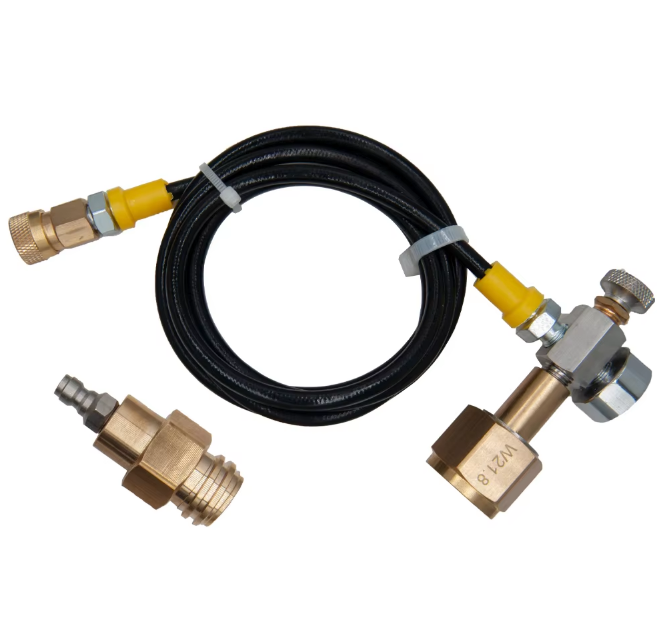
Thread Standards Behind the Confusion
Connecting a SodaStream machine to an external CO2 tank sounds straightforward until the first adapter arrives with the wrong thread. The core issue sits in two thread families that look similar in product photos but behave very differently under pressure. TR21-4 is a quick connect interface found on the Terra, DUO, and ART series, while G1/2 is a straight pipe thread common on older carbonation rigs and many industrial gas fittings. Understanding the geometry before ordering saves time, money, and a kitchen counter covered in gas.
TR21-4 threads are not really threads in the traditional sense. The connection uses a push-in collar with internal lugs that lock onto the machine port. It seals through an O-ring at the base, not through thread compression. This design allows a tool-free attachment, but it also means the adapter must match the exact port diameter and lug spacing. A slight variation in machining tolerance leads to a wobble that can unseat the seal under tank pressure.
G1/2 follows ISO 228 parallel thread conventions. The thread pitch is 14 threads per inch, and the seal comes from a bonded washer or O-ring compressed at the shoulder, not from the thread flanks. Many CO2 regulators and older home carbonation kits use G1/2 because it is widely available and easy to machine. However, a G1/2 adapter will not click into a Terra or DUO port. The two interfaces simply do not share a mating surface.
What TR21-4 Actually Means on Modern SodaStream Machines
SodaStream moved to a proprietary quick connect system for the Terra and DUO to reduce user error and speed up cylinder swaps. The TR21-4 designation refers to the port profile, not a standard governed by a global body. That creates a challenge for third party adapter makers. Without a published specification, each manufacturer has to reverse engineer the geometry from original cylinders and machine parts.
Field observations from a small beverage equipment repair shop highlight why this matters. A technician once received a batch of adapters that fit loosely in the DUO port but sealed fine on a Terra unit. The difference came down to a few hundredths of a millimeter in the locking lug height. On the DUO, the port collar sits slightly deeper, so the lugs did not fully engage. The result was a slow CO2 leak that only appeared after the machine sat overnight. This kind of tolerance sensitivity is common with quick connect gas fittings and explains why cheap adapters often fail silently.
G1/2 Threads and Their Role in CO2 Setups
G1/2 threads appear on many CO2 regulators, manifold blocks, and refill stations because the parallel thread with a shoulder seal handles high pressure well. A typical CO2 tank regulator might operate between 0 and 60 bar on the low side, while the high side sees cylinder pressure around 50 to 60 bar at room temperature. G1/2 fittings can handle this range when the washer is in good condition and the shoulder is clean.
But the strength of G1/2 also creates a compatibility trap. Users see a G1/2 threaded regulator and assume it will attach to any adapter with a similar outside diameter. The TR21-4 port looks similar at a glance, but it is not a pipe thread. Threading a G1/2 male into a TR21-4 female port will either jam or strip the plastic housing, depending on how much force is applied. Replacement machine ports are not cheap, and the plastic shavings can end up inside the carbonation line.
Real World Fitment: A Shop Floor Observation
A beverage service crew in a humid coastal city ran into a fitting mismatch that illustrates the difference clearly. They were converting a fleet of small office soda machines from disposable cylinders to a central CO2 tank system. The main tank used a standard CGA320 valve, and the machines were a mix of older screw-in models and newer Terra units. The crew ordered G1/2 adapters because that matched the regulator on their manifold. The older machines worked immediately. The Terra units would not accept the adapter, and two technicians spent an afternoon trying to force the connection before realizing the port design was different.
The fix involved a CGA320 to TR21-4 adapter with a braided hose, which allowed the same central tank to feed the newer machines. This setup eliminated the need to keep two regulator types in inventory. The key lesson was that thread naming alone does not predict fitment. The connection method, seal location, and locking mechanism matter just as much as the nominal size.
Comparing Fit, Sealing, and Everyday Use
The table below summarizes the main differences between TR21-4 and G1/2 in the context of SodaStream conversions.
| Feature | TR21-4 Quick Connect | G1/2 Thread |
|---|---|---|
| Common Use | SodaStream Terra, DUO, ART | Older carbonation rigs, industrial regulators |
| Connection Type | Push-in collar with lugs | Straight pipe thread with shoulder seal |
| Seal Method | O-ring at port base | Bonded washer or O-ring at shoulder |
| Tool Requirement | Usually none | Wrench often needed |
| Tolerance Sensitivity | High, lugs must match exactly | Moderate, thread pitch is forgiving |
| Leak Risk | Loose fit causes slow leak | Damaged washer causes immediate hiss |
Choosing Without Overbuying
The right choice depends on the machine port, not the tank. If the machine is a Terra or DUO, a TR21-4 adapter is required. If the machine has an older threaded socket, G1/2 may work, but checking the thread pitch is still necessary because some models used a different standard. A digital caliper and a thread gauge cost little and remove most guesswork. A machine port also wears over time, so an adapter that fits tightly on day one may need a fresh O-ring after several months of use.
Buying a high quality adapter matters more than buying multiple cheap ones. Machining tolerances in the locking lugs and the O-ring groove determine whether the connection seals at full cylinder pressure. A poorly cut groove can pinch the O-ring and cause a leak that stops only when the tank is nearly empty. This is why some users report a full tank lasts half as long as expected, the gas escapes slowly around the fitting.
HXJ has focused on CNC hardware machining for many years, and that background shows in the small details of adapter production. The locking lugs, thread profiles, and seal grooves come off the same production line that handles precision components for more demanding applications. For businesses that supply soda adapter kits or maintain beverage equipment, that kind of consistency reduces field failures and keeps the supply chain predictable.