
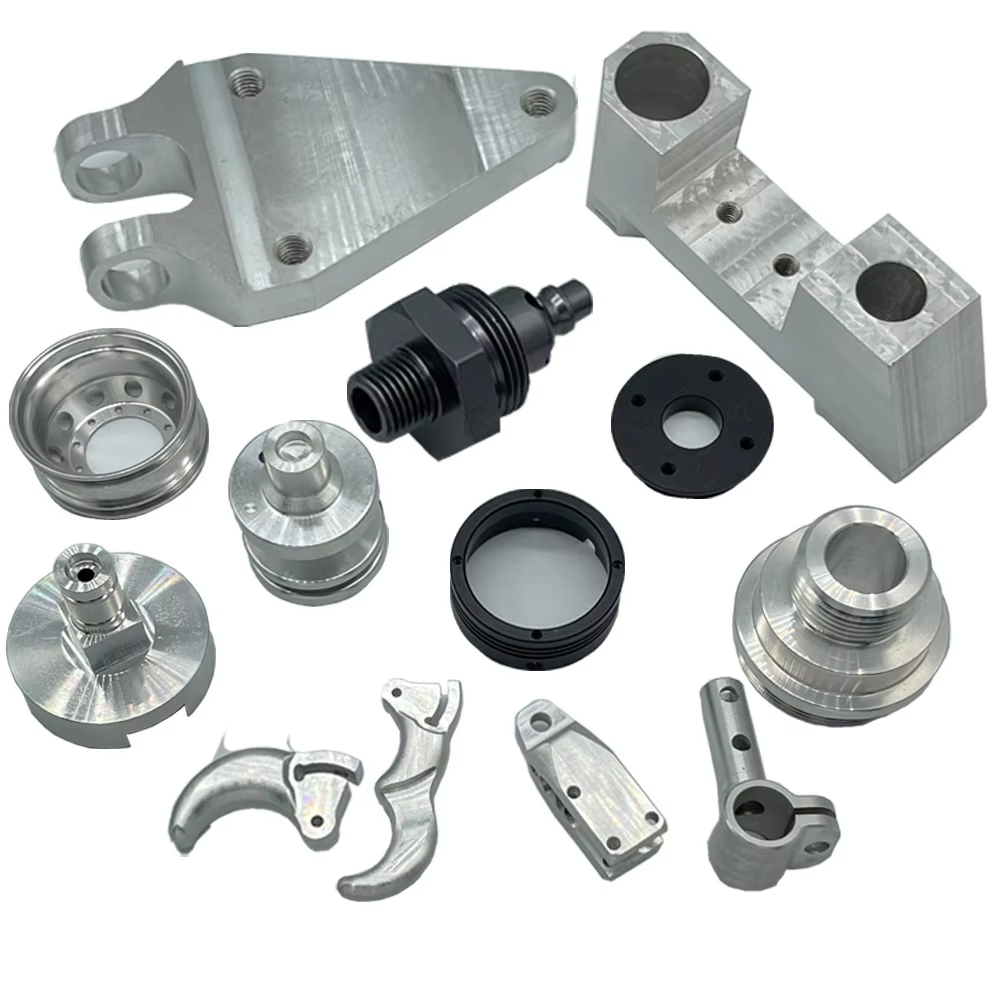
Precision and Tolerance Control: The Foundational Benchmark of CNC Machining
How Rigorous Process Control Achieves Consistent Sub-Micron Accuracy
When talking about precision in CNC machining, it's really about having control over the entire process as it happens—not just relying on what the machine can do alone. Most shops routinely hit dimensional tolerances around ±0.0001 inches (or about ±0.0025 mm) thanks to properly calibrated instruments, those smart feedback loops we've all come to rely on, plus careful attention to workshop conditions. What makes this possible? Well, modern systems keep tweaking cutting settings while the part is actually being made. They compensate for things like heat causing materials to expand or tools bending slightly during operation. This approach cuts down on size changes by roughly 60% when compared to older methods that didn't have such adjustments built in. Shops maintain tight control by checking everything daily with laser interferometers, keeping total errors well under 0.1 microns. And for those super important parts used in aircraft manufacturing, this level of meticulousness results in surface profiles staying within 1.5 microns deviation from specifications. That meets all the strict AS9100 requirements without needing any extra polishing or finishing steps later on.
Machine Rigidity, Real-Time Tool Wear Compensation, and Environmental Management
Sustaining sub-micron repeatability demands integrated control across three interdependent domains:
- Structural Integrity: Machines built with polymer-concrete bases and linear motor drives suppress vibration, cutting chatter-induced inaccuracies by 45%
- Adaptive Tool Management: Embedded sensors monitor edge degradation and trigger automatic tool offsets—or replacement—when wear exceeds 15 µm
- Environmental Stability: Temperature is held to ±0.5°C, and ISO Class 7 cleanrooms mitigate particulate interference that could compromise surface integrity
| Control Factor | Standard Machining | High-Precision CNC | Impact on Tolerance |
|---|---|---|---|
| Thermal Compensation | Passive | Active (0.1µm/°C) | ±0.0002" vs. ±0.00005" |
| Vibration Damping | Cast iron frames | Granite/epoxy composites | 40% lower surface waviness |
| Metrology Integration | Post-process | In-process (every 5 mins) | 90% faster deviation correction |
This holistic framework transforms theoretical precision into production reality—enabling 99.8% first-article pass rates for medical implant components at ±5 µm positional tolerances.
End-to-End Quality Assurance in CNC Machining: Calibration, Inspection, and Certification
Pre-Process Calibration, In-Process Monitoring, and Post-Machining Metrology
Quality control doesn't really start until after the first piece has been made. Before any cutting happens, technicians need to calibrate everything properly. They check how the machines move, look at spindle runout issues, and make sure axes are aligned correctly according to industry standards. This helps keep all parts working within very tight tolerances measured in microns. When actual machining takes place, there are sensors built right into the equipment that monitor temperature changes and wear on tools as they go. These sensors send information to computer systems which adjust settings automatically so the final product stays accurate within about 0.005 millimeters, something especially important for long production runs in aerospace manufacturing. Once machining is complete, Coordinate Measuring Machines (CMMs) come into play to confirm that dimensions meet geometric requirements. Surface roughness measurements also get taken using special instruments called profilometers. For certain applications like medical implants, surfaces must be incredibly smooth with a roughness value below 0.4 micrometers. This level of finish prevents bacteria from sticking and ensures the implant works properly inside the body without causing problems.
ISO 9001 and AS9100 Certification as Evidence of Systemic CNC Machining Excellence
When it comes to proving that a manufacturing site actually cares about quality beyond just having shiny machines, certifications from outside experts matter a lot. The ISO 9001 standard basically forces companies to write down all their processes, figure out what happens when things go wrong, and keep getting better at what they do. According to recent data from 2023, facilities following this approach see defects drop by almost half compared to those that don't bother. Then there's AS9100 which takes everything ISO requires and applies it specifically to industries like aerospace and defense. This means manufacturers have to plan for risks upfront, track every component through the entire supply chain, and use math to monitor production quality. Companies with both ISO 9001 and AS9100 certifications tend to run incredibly smooth operations. Nearly all parts (about 99.8%) pass initial inspections right away, so no need for fixing mistakes later. That saves money and gets products ready for actual use much faster whether they're going into airplanes or medical devices.
Surface Finish and Material Integrity: Beyond Dimensions to Functional Performance
Optimizing Cutting Parameters, Toolpath Strategy, and Coolant Delivery for Target Ra and Microstructure
Surface finish is not cosmetic—it governs fatigue life, corrosion resistance, sealing capability, and biocompatibility. A part’s Ra value directly reflects subsurface integrity: excessive heat or mechanical stress can induce microcracks, work hardening, or phase changes that compromise long-term reliability. Achieving Ra <0.4 µm requires tightly coordinated optimization:
- Cutting speeds, feeds, and depths of cut must be tuned to material-specific thermal conductivity and ductility
- Adaptive clearing distributes heat load; trochoidal milling reduces radial tool forces; contour-parallel paths improve finish uniformity
- High-pressure, precisely directed coolant prevents localized heating—preserving microstructure in sensitive alloys like Ti-6Al-4V and Al 7075
This level of control ensures surfaces perform as designed—not just look smooth—extending service life and enabling function-critical applications from orthopedic joints to turbine blades.
Advanced CNC Programming and Multi-Axis Capability: Enabling Complexity with Predictable Repeatability
CAD/CAM Integration, G-Code Validation, and Simulated Machining for First-Part Success
When working with multi-axis CNC machines (those with four or more axes), manufacturers can tackle far more complex geometries while cutting down on errors. The main reason? These systems eliminate the need for manual part repositioning during machining, which often leads to alignment issues caused by fixtures. But getting all these advantages requires something else too good CAD/CAM software integration. With proper setup, digital blueprints actually guide the creation of smart toolpaths. Before cutting even starts, engineers run simulations based on real-world physics to check everything out. They look for potential collisions, verify how much material gets removed, and test if the machine's movements stay within safe limits. All this upfront checking means most shops report over 98% success rate on their first attempt when making precision parts that require tight tolerances.
- Reduced Setup-Induced Errors: 5-axis machining cuts required setups by 60–80% versus 3-axis alternatives, minimizing cumulative positioning uncertainty
- Dynamic Toolpath Optimization: Continuous tool orientation adjustment enables precise machining of undercuts, impeller blades, and organic contours—while holding Ra <0.4 µm
- Predictable Repeatability: When paired with real-time tool wear compensation and thermal modeling, multi-axis systems sustain ±0.005 mm tolerances across full production runs—without sacrificing complexity.
FAQ
What are the main factors influencing precision in CNC machining?
Precision in CNC machining depends on several factors, including thermal compensation, vibration damping, and real-time metrology integration. These ensure the machine operates with minimal errors and deviations.
Why is certification such as ISO 9001 and AS9100 important in CNC machining?
Certifications like ISO 9001 and AS9100 indicate that a manufacturing facility adheres to stringent quality management systems and industry-specific requirements, ensuring excellence in production quality and process management.
What role does surface finish play in the functionality of machined parts?
Surface finish impacts crucial aspects such as fatigue life, corrosion resistance, and biocompatibility. Properly optimized sub-surface integrity enhances reliability and performance in function-critical applications.
How do multi-axis CNC machines improve machining processes?
Multi-axis CNC machines reduce setup errors, enable dynamic toolpath optimization, and ensure repeatable accuracy across complex geometries, leading to increased efficiency and reduced production errors.
Table of Contents
- Precision and Tolerance Control: The Foundational Benchmark of CNC Machining
- End-to-End Quality Assurance in CNC Machining: Calibration, Inspection, and Certification
- Surface Finish and Material Integrity: Beyond Dimensions to Functional Performance
- Advanced CNC Programming and Multi-Axis Capability: Enabling Complexity with Predictable Repeatability
- FAQ